Saturday, April 8, 2017

GEORGE WASHINGTON MASONIC NATIONAL MEMORIAL

(November 12, 2016) Last fall I returned to Northern Virginia and our Nations Capital for a quick weekend vacation.  Whenever I visit the Northern Virginia Area I always stay outside of the beltway and use the Metro Rail as my primary mode of transportation.

On this trip I opted to stay down in Fredericksburg and drive up Interstate 95 to the Springfield Metro Station. Traffic on Interstate 95 was still very heavy even for a weekend but nothing like weekday rush hour.  It's about 45-miles from Fredericksburg to the Springfield Station which has a large parking garage and parking is free on weekends.

It took me about an hour and 20 minutes to make the 45-mile trip. I had already loaded my Metro Smart Card so I proceeded straight to the platform and waited about 10-minutes for my train. The Metro Rail Service is undergoing a multi-million dollar upgrade and some service and stations are closed at various times. Today, I would be riding the Blue Line, which is running on time and not currently on the maintenance schedule.

I have ridden the Metro Rail service several time and have never had a problem. The stations and platforms are for the most part clean as are their trains. The only issue is some of the station employees are rather rude and abrupt when dealing with passengers.

About 10-minutes after arriving on the platform, my train pulled in and strange as it seemed I boarded and had the entire car to myself. There were only a couple of people on the platform waiting to board and they boarded the car in front of me.

It was just a short 15-minute ride to the King Street Station, where I left the train and made my way about a half a mile up the hill to the George Washington Masonic National Memorial.

This impressive structure dominates the area and sits atop Shooter's Hill in Alexandria, Virginia.  For George Washington, joining the Masons was a rite of passage and after becoming a Master Mason in 1753 and passed through a series of additional rites that would see him become the first Worshipful Master of the Alexandria Lodge Number 22 in 1788, just a few months before becoming the first President of the United States.

On May 7, 1909, The Grand Lodge of Virginia call for all lodges in the United States to meet in Alexandria. On February 22, 1910, which was Washington's 178th birthday, the George Washington Masonic National Memorial Association was formed for the purpose of constructing a memorial temple to honor "Brother" George Washington.

Over the next 12-years enough money was raised and construction began on June 5, 1922. It took more than 10-years to complete the building as construction could only continue as funds were raised. Finally after 10-long years of construction, the George Washington Masonic National Memorial was dedicated on May 12, 1932.

Washington's Statue in Memorial Hall
After spending some time walking around the grounds, I walked inside and signed up for one of the five daily guided tours. Having arrived right at 9 a.m. I was able to get into the first tour of the day at 9:30.

We began out tour in what is probably the Memorials most impressive rooms; the Memorial Hall. The hall features eight grand columns that stand more than 40-feet tall and are 4-feet wide. The hall also feature two giant murals showing Washington and is officers attending a service at St. John's Church in Philadelphia on December 28, 1778. The mural on the south wall shows President Washington laying the cornerstone of the U. S. Capitol on September 18, 1793.  The room is dominated by a larger than life statue of President Washington in his Masonic regalia. This statue was created by Bryant Baker and dedicated by President Harry Truman in 1950.
Strand of Washington's Hair

On the third floor we learned about the "Family of Freemasonry," with exhibits relating to many masonic organizations including The Order of the Eastern Star, The Tall Cedars of Lebanon and Grottoes of North America.  The exhibit also features the colorful robes and vestment worn by the various organizations.
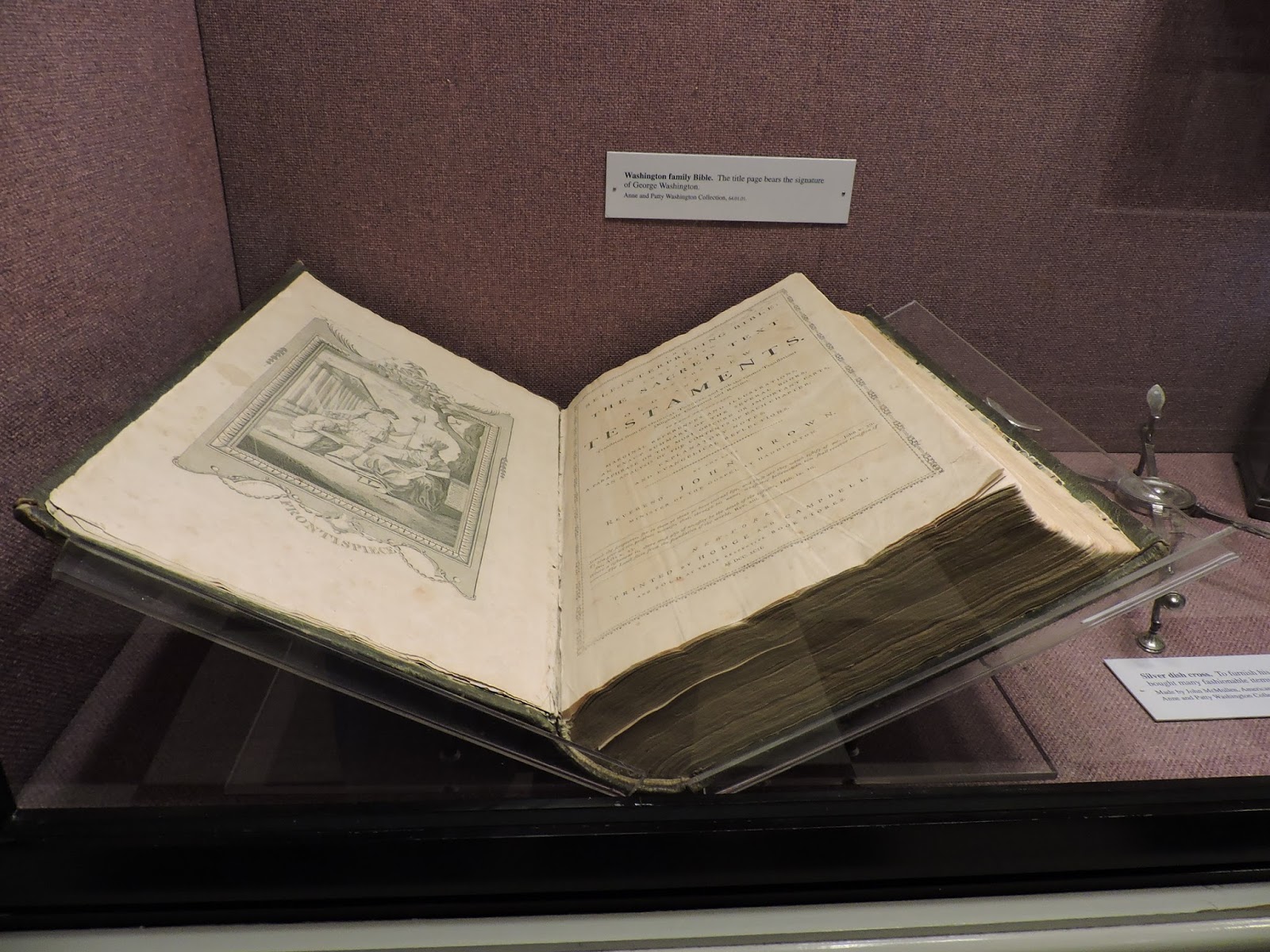
Washington's Bible
Perhaps my favorite room was the museum, which is located on the 4th Floor. Exhibits include a strand of Washington's hair, his family bible that bears his signature and a candle carried at his funeral.

After touring the Replica Lodge Room and the Knight Templar Chapel, we packed ourselves into two
View from the Observation Deck
small elevators and made our way to the 9th Floor which opens up to the outdoor observation deck. All I can say is WOW!!!!!!, What a view. The day was clear and sunny and from the observation deck we could see the Capitol and Washington Monument in distance as well as seeing planes landing and taking off at Reagan
National Airport. The view itself is will worth the price of admission.

The guided tour ends on the observation deck and we were free to revisit the Memorial Hall and other areas of the memorial.  I really enjoyed my visit and would encourage anyone in the Northern Virginia area to make time for this wonderful memorial.

Here is a short Video from my visit to the George Washington's Masonic National Memorial


Friday, March 31, 2017

OFF DAY IN GREENVILLE

(March 18, 2017) While the NCAA Men's Basketball tournament continued at other sites, there were no games scheduled for Greenville on Saturday. This gave me the Opportunity to get out and explore the area. As I drove through Greenville, I round several streets were blocked off for some kind of running event, so I headed back to Interstate 85 and made my way south toward the tiny town of Royston, Georgia.

Mos people don't play on going to Royston, they end up in Royston, but for me this was a planned trip. Royston is the town of one of the most immortal names in Baseball, Tyrus Raymond Cobb.  Ty Cobb was the first inductee into the National Baseball Hall of Fame and one of the true legends of the game.

As you drive through this small town it is evident that its citizens not only embrace his legacy but truly love the man.  Everywhere you look you see the name Ty Cobb. From the Community Center to the Ty Cobb Medical Center, it is obvious that this baseball legend was a philanthropist who really gave back to his hometown and
community.

The reason that I drove the hour and 20-minutes from Greenville to Royston was to visit the Ty Cobb Museum. The small museum is located in a wing of a small medical office building in downtown Royston.

The Ty Cobb Museum is a very small museum which features a number of artifacts that personally belong to the baseball great. When I tour a museum, I am a "reader," I enjoy reading the plaques and information that is available. With that being said, I spent about an hour walking through the exhibits, which featured Ty Cobb's Bible, Uniforms and shotgun along with other personal artifacts.

Just a short drive (less than a mile) from the museum is Rose Hill Cemetery, where Ty Cobb, his wife and mother and father are resting in a family mausoleum.  You have no trouble finding the mausoleum as it is the largest structure in the Cemetery.  I made a quick trip out to the cemetery before heading back toward South Carolina.

My next stop of the day was the small town of Pendleton, South Carolina. I wanted to stop of the Old Stone Church, which is one of the oldest churches in the upstate of South Carolina. However, there was a wedding going on and not wanting to be a "wedding crasher," I ventured over to the St. Paul's Episcopal Church. It is here in the church cemetery that Thomas Green Clemson and his wife Anna Calhoun Clemson are buried.

Thomas Clemson is the founder of Clemson University. and his wife Anna Calhoun is the daughter of Vice President John C. Calhoun. Following Vice President Calhoun's death in 1850, Thomas and Anna eventually inherited the Fort Hill Plantation.  It was from Fort Hill that Clemson founded the agricultural college that is today known as Clemson University.

General Barnard Bee


Also resting here in the church cemetery is Civil War General Barnard Elliott Bee. It was during the first battle of Manassas on July 21, 1861 that Bee uttered the words, "Rally around the Virginians, There stands Jackson like a stonewall." From that day forward General Thomas J. Jackson would be known as "Stonewall" Jackson. The next day on July 22, 1861, General Bee was kill on the battlefield at Manassas.

After finishing my quick visit to St. Paul's Church, I made a short drive up to Clemson University. My first stop was at Woodland Cemetery. It is here, in the shadow of Clemson's Memorial Stadium that legendary football coach Frank Howard is buried.  It was Howard that started referring to Memorial Stadium as Death Valley.

Also located at Woodland is the Fort Hill Plantation Cemetery and the Calhoun Family Cemetery. While Vice President Calhoun is buried in Charleston, several of his relatives are buried here.

Coach Howard's Rock
Just a short walk down the hill from Woodland Cemetery, is  Memorial Stadium, which is home to  2017 NCAA National Football Champions. Today the east gate was open and visitors could actually touch Howard's Rock and run down the hill.

A few years back I was able to attend the Clemson - Wake Forest Game here at Memorial Stadium. I must say if you are a college football fan, then attending a game in Death Valley should be on your bucket list. There is no way to describe the scene when the Tigers rub Howard's Rock, run down the hill and 85,000 people erupt. It is a totally awesome environment.

Fort Hill Plantation House
Just a short walk up the hill from Memorial Stadium is all that remains of the original Fort Hill Plantation; the home of Vice- President John C. Calhoun. When Calhoun died in 1850 the plantation was divided among his children. The home eventually became the home of Vice President daughter Anna Calhoun and her husband Thomas Green Clemson.

When Anna died in 1875, Thomas inherited the property. In his will Clemson bequeathed the property to the State of South Carolina for the purpose of establishing an agricultural college which is today known as Clemson University. Thomas also stipulated that the Fort Hill Mansion should never be torn down or altered and it should always be open for "Public Inspection." Today, Clemson University has preserved the historic home as a museum which contain almost all of the original furnishings.

By the time I finished with my visit to Clemson it was time to head back toward Greenville, but I had one more stop to make before returning to my hotel. Woodlawn Memorial Park is just a short drive up from my hotel on Plesantsburg Road and it is the final resting place of the one of the greatest baseball players who is NOT in the Hall of Fame, Joseph Jefferson "Shoeless Joe" Jackson.

In 1919 "Shoeless Joe" was a member of the Chicago White Sox who played in the World Series. Jackson discovered that seven players had gotten together to throw the World Series. He was offered $20,000 to join them but  adamantly declined. The gambler used his name to lure bettors and as a result Commissioner Kennesaw Mounatin Landis banned all of the player from professional baseball for life. Following the ban Joe returned to Greenville where he became a successful shop keeper, running a dry cleaning business and later a liquor store.  He lived the rest of his life here in Greenville and died of a heart attack in 1951.

After paying my respects to "Shoeless Joe" I ended my day with dinner at Sticky Fingers BBQ and returned to my hotel to watch the evening session of the tournament.

Monday, March 27, 2017

2017 NCAA BASKETBALL TOURNAMENT - GREENVILLE, SC

(Greenville, SC - March 17, 2017) For the 17th Straight year I have traveled to the first and second rounds of the NCAA Men's Basketball Tournament. My first trip was just a day trip to Greensboro, North Carolina in 2001. My second year I managed to get a little more adventurous and traveled to Greenville, South Carolina. The side story on that is, following the 2002 tournament the NCAA banned the state of South Carolina from hosting any future NCAA Championship events because of the Confederate Flag that was still flying on the grounds of the State Capitol in Columbia.  The Confederate Flag was retired from the grounds in 2015 and the Tournament returns to Greenville for the first time in 15 years. Oddly, the tournament left Greenville, because of politics and this year it returns to Greenville because of politics. 

This years tournament was originally slated to be held at the Greensboro Coliseum in Greensboro, North Carolina, but because of what is known as the "Bathroom Bill" the NCAA decided to remove all of its championship events from the state of North Carolina. So the tournament returns to Greenville.

I Have Great Seats
So, after 15-years I return Greenville. When I attended the tournament here in 2002 the arena was known as the Bi-Lo Center, now it is know as the Bon Secours Wellness Arena. The one thing about the is disappointing about returning to this arena is that they prohibit any camera's with detachable lenses, which means that I will not be not be able to get my gook Nikon Cameras into the arena, so most of the photo will be taken by my cell phone.  The NCAA didn't do me any favors in seeding the teams this year as I have two of the ACC big dawgs, Duke and North Carolina seeded here. In addition to the Devils and Heel being here in Greenville I also have what I think will turn out to be the "HOME" team, the South Carolina Gamecocks. The rest of the teams seeded here are the Arkansas, Troy, Seton Hall, Marquette, and Texas Southern.

The schedule for the First day of the tournament has Duke and Carolina split between the afternoon and evening session. One thing about NCAA Scheduling, is that they have sold their soul to the TV Devil.  The TV Networks set all of the game times and for what ever reason the afternoon games here in Greenville were late starts. The first game wasn't scheduled to begin until 1:20 p.m. and game two is schedule for 4:30 or 30-minutes after the conclusion of the first game. 

AFTERNOON SESSION:
Arkansas vs. Seton Hall
North Carolina vs. Texas Southern

I tried to get my good Nikon in and was turned away at security so there won't be many photo during this tournament. The first game of the day saw the Razorbacks defeat the Pirates by a score of 77-71. The second of the afternoon session saw the Tarheels pound the Troy Tiger 103-64.

After the conclusion of the first session, everyone was forced to exit the arena and re-enter for the evening session with the first game scheduled to tip at 7:20. This is another quirk of the TV Scheduling. With the late start of the Afternoon session and the early start of the evening session makes for a quick turnaround. I had a similar schedule a few years back in Kansas City and the event staff there did not handle the quick turnaround very well. In fact, I missed the first 6-minutes of the first game. 

I must say here in Greenville they were much better prepared as the doors re-opened about 40-minutes before the scheduled tip. I tried one more time to get the Nikon through security without success. I think I am going to give up on tournament photo this year. 


EVENING SESSION:
Duke vs. Troy 
Marquette vs. South Carolina

The evening session started off with Duke having a little more trouble with Troy than the Tarheels had with Southern. But when it was all over the Blue Devils came out on top 87-65.  The final game of the first day here in Greenville was perhaps the most anticipated game of the day.  The NCAA mixed in a little sub plot. It featured the Marquette Warriors which is coached former Duke player and assistant Coach Steve Wojciechowski against the South Carolina Gamecocks. You can't tell me that the selection committee didn't think it would be interesting if Marquette and Duke both win, the story line would be the Student takes on the Teacher.  But first, Marquette has to take on South Carolina.  Another interesting sub-plot is that the Gamecocks is playing just 90-miles from their campus in Columbia. 

The Gamecock nation traveled well and the "Cock" had a the majority of the fans and the home court advantage.   When all was said and done the Home team defeated the Warriors by a score of 94-73. The Marquette - South Carolina game brought the curtain down on day one of the NCAA Tournament here in Greenville and set the stage for an interesting two games for round two on Sunday.


Sunday, January 29, 2017

WHEELING, WEST VIRGINIA

Back on Memorial Day weekend in 2012 I took a little mini vacation to through Ohio, West Virginia and Pennsylvania. A lot of the journey took me along the historic National Road.  One such stop was in the historic river town of Wheeling, West Virginia.  The National Road run right through downtown Wheeling and crosses the Ohio River on a suspension bridge that was built in 1849. With a total length of 1,010-feet is one of the longest and oldest pre-Civil War bridges still in use today. It is still open to vehicle traffic, with a weigh limit of 2-tons or less.  The historic bridge was listed on the National Register of Historic Place in 1975.

Just down the street from the suspension bridge is the historic Capitol Music Hall. From 1926 until 1977 the Capitol Music Hall was the setting for "Jamboree USA, a live country music radio show broadcast live over clear channel WWVA - 1170 AM. The Jamboree was the second longest running radio show in the United States; only the Grand Ole Opry has had a longer run.  Some of the greatest stars in country music, including Hank Williams, Roy Acuff, Ernest Tubb and Bill Monroe have performed on the stage of this historic building.

Here is a short video taken highlighting my visit.


TOMBSTONE TOURIST VISIT MARYLAND


Green Mount Cemetery
When Traveling I like to spend time visiting Old and Historic Cemeteries so I have been labeled the Tombstone Tourist. While on a recent trip to Maryland for the Military Bowl I had the opportunity to visit Baltimore and the Historic Green Mount Cemetery. Driving up from Annapolis my GPS took me through downtown Baltimore.  The area surrounding Green Mount Cemetery is not the best and anyone visiting here should remain aware of their surrounding. As I was getting close to the cemetery the neighborhood got progressively worse and it looked like some of the building had been burned in the riots last year. It seems that the politically correct term for what happened is protests, but anything that does this much damage is a riot.  As I pulled into the cemetery, I stopped at the office. This is a very, very large cemetery and I needed to Pick up a map and also all visitors are required to register with the office before entering.  I signed in and picked up my map that included the locations of more than 70 of the most visited graves.  It was a cold, rainy morning as I drove through the cemetery beginning my search for some of Baltimore's most historic and notable figures.

General Joseph E. Johnston
One of my target graves was that of General Joseph E. Johnston.  I found it interesting that General Johnson surrendered the last and largest number of the Confederate Forces during the Civil War. On April 26, 1865, some two weeks after General Lee Surrendered at Appomattox, General Johnston surrendered more than 89,000 Confederate Troops to General William T. Sherman at Bennett's Place near Durham, North Carolina.  One thing that I found Interesting was that following the war General Sherman and General Johnston became close friend. The two was so close that when General Sherman died in February 1891, General Johnston served as a pallbearer at his funeral.  It was a cold rainy day but out of respect for for his friend General Johnston refused to wear a hat and as a result caught pneumonia and died a few weeks later.

Samuel Arnold
 Also buried here is Johns Hopkins, the founder of Johns Hopkins Hospital and Johns Hopkins University.  His grave is located near the Chapel, and the grave of Maryland's Longest serving Governor, Albert Richie.  Governor Richie served for over 15-years as Maryland's 49th Governor.   On top of the hill near the large mausoleum I found the grave of Samuel Arnold, who was involved in the original plan to kidnap President Abraham Lincoln. Although he withdrew from the plot prior to Lincoln being assassinated by John Wilkes Booth, Arnold and Dr. Samuel Mudd were both found guilty of conspiracy and sentenced to life in prison at Fort Jefferson off of the Coast of Florida. In 1869, President Andrew Johnson pardoned both Arnold and Mudd.  Both men returned to Maryland and lived out the rest of their lives.  After being released from prison, Arnold lived quietly for more than 30-year. Samuel Arnold died on September 21, 1906. Only a simple white stone with the name Arnold, marks his grave.

Elizabeth Patterson Bonaparte
When walking through cemeteries, I often find something unexpected and interesting.  This was the case when I stumbled on the grave of Elizabeth Patterson who was the wife of Jerome Bonaparte. Jerome was the brother of Napoleon Bonaparte who strongly disapproved of the marriage. When Jerome and Elizabeth tried to return to France, Napoleon refused to allow Elizabeth to enter the country.  She was exiled to England and Napoleon had the marriage annulled. Elizabeth Bonaparte returned to being Elizabeth Patterson and returned to America where she lived out the rest of her life.

John Wilkes Booth
My final stop in Green Mount Cemetery was at probably the most visited grave in the cemetery; the grave of John Wilkes Booth. A couple of weeks after shooting President Lincoln at Fords theater, Booth was located by U. S. Soldiers in a barn on the farm of Richard Garrett, near Port Royal, Virginia. Refusing to give up a soldier named Boston Corbett shot Booth in the barn, and he died a few hours later. President Lincoln's Assassin is officially buried in an "unmarked" grave in the booth family plot.  The only mention of John Wilkes Booth is on the family grave monument which lists the name of Julius Booth's children. While the cemetery maintains that his grave is unmarked, many people think that a small white stone at the corner of the family plot actually marks his grave.

After finishing my visit to Green Mount Cemetery, I made my way back through Baltimore and headed north toward the Dulaney Valley Cemetery in Cockeysville, Maryland. The Dulaney Valley Cemetery is a modern cemetery with flat ground markers which makes his difficult if not impossible to locate specific graves.  While Find-A-Grave is very helpful the GPS coordinated posed for individual graves are often incorrect.

Spiro T. Agnew
I stopped by the office and while they don't offer a map of famous graves the staff did provide me with the locate of Spiro T. Agnew grave.  Agnew was Vice President of the United States under Richard Nixon.  During his term in office he was investigated for corruption and became only the second vice president to resign the office. John C. Calhoun was the first.  Even with the map I was having great difficulty locating his grave.  A very helpful cemetery worker came to my rescue and not only took me right to his grave but gave me direction to a couple of other famous people who are resting here.

Johnny Unitas
With the help of the cemetery worker I was able to visit the final resting place of NFL Hall of Famers Johnny Unitas and Art Donovan.  Both are resting in a very peaceful location on the banks of a small lake near the cemetery entrance. Both played most of their careers with the Baltimore Colts and were two of the teams most beloved figures.

Francis Scott Key


After visiting Dulaney Valley it was time to head west and toward home.  I made my way out Interstate 70 and it was very late in the afternoon when I pulled into the Mount Olivet Cemetery in Frederick, Maryland. I had been here several years ago and wanted to once again visit the grave of Francis Scott Key, who composed the words to the Star Spangled Banner which became out National Anthem. Key is buried below the impressive monument at the cemetery entrance.

It was very cold and windy in Frederick and after visiting the Key grave I made a quick stop at grave of Civil War Folk Figure Brabars Fritchie and Maryland's first Governor Thomas Johnson.  Both graves are located very close to each other and allowed for a very quick stop. Here is a short video of my visit to these cemeteries.

Mount Olivet was the final stop on my visit to the historic cemeteries of Maryland and I headed home the cold wind and rain turned into blowing snow as I made my way down Interstate 81.