Saturday, June 3, 2017

CHASIN' THE 611 - MEMORIAL DAY WEEKEND 2017

Elliston
For the past two month the historic 611 steam locomotive has been pulling excursions in North Carolina and Virginia. The last of these excursions occurred over the Memorial Day Weekend with The Powhatan Run between Roanoke and Radford.  This is one of the shorter but one of the most scenic and most popular routes of the 2017 excursion season. The route takes passengers through Roanoke and Salem before climbing the famed Christiansburg Grade in Elliston and Sahwsville.  One of the most popular sites on the run is the twin tubes of the Montgomery Tunnel, which was made famous through the photography of O. Winston Link.  The train continues through Christiansburg passing the Cambria Depot.


Montgomery Tunnel
From 1868 to early 1950s, the Cambria Depot was the shipping point for all the goods coming into and leaving Montgomery and Floyd Counties, including the Towns of Christiansburg and Blacksburg. Every Sears mail-order house and Wishbook gift; every letter and package; every rug and factory chair and wedding dress sold by the mail order firms from New England to the West Coast; every Model T and Stutz Bearcat; and every secret decoder ring came through the Cambria Depot.
From 1868 until 1906, the Cambria Depot also served as the passenger station, including during the height of immigration. The depot and Cambria welcomed the miners from Wales and Czechoslovakia, farmers from Germany and Ireland, cabinetmakers and home-builders, masons and seamstresses. The languages spoken in the freight-house were as diverse as the last names in the County.

Elliston
In 1906, the Norfolk and Western built a new passenger station on a site east of the old depot and on top of a small spring fed pond (and we wonder why we have stormwater problems), and the old depot was converted to a freight station and a maintenance of ways & engineering office. The new station was built, not because there was a need for a new passenger station per se but because of the political, social, and cultural demands for segregation. The old depot, one of only a couple of pre-segregation depots left in Virginia, could not be segregated because of the configuration of the waiting rooms.
In its heyday, Cambria boasted of five mercantiles and general stores, a china shop, a notions shop, the Phoenix furniture factory, a grocery store, a couple of banks, more than a couple of hardware stores, three mills of various types, a creamery, four hotels, and more than its share of bars, brothels, and pool halls. She also had her share of ugliness-- a history marred by the racial divides made worse by economic woes.

Spring Hollow
Like most railroad towns, Cambria went through a period of decline, resulting in consolidation with a larger neighbor (Christiansburg) in 1965. The construction of Route 11 and Route 8 in the 1930s, increased automobile ownership, and the introduction of truck transport and bus service from Roanoke following the end of World War II spelled the end of Cambria's role as the primary shipping and immigration point for Montgomery County, Floyd County, and eastern Giles County. 
(Source/Credit: VISIT HISTORIC CAMBRIA)

From Christiansburg the excursions continues west passing under the coaling tower at Vicker Switch before arriving in Walton to make the turn and return to Roanoke.

Along the way The Powhatan routes affords you several great Photo opportunities to see the Queen of Steam. Over the three days of the excursion I was lucky enough to get some decent photo and video from West Salem, Spring Hollow (Arthur on the Norfolk Southern Route) The Christiansburg Grade at Shawsville and at Montgomery Tunnel.

Here is the Video from my three day chase. It's not my best work but it is what it is.


Wednesday, May 17, 2017

THE TOMBSTONE TOURIST VISITS OHIO

I'm going to make this a really short entry as most of this has been covered in previous posts. This posts features a short video made from the photographs that I have taken during my travels around the Buckeye State.  During each of my visits I had the opportunity to visit a number of cemeteries. Some were very large cemeteries like Spring Grove in Cincinnati, while other were small rural cemeteries like Rushtown Cemetery in Rushtown, Ohio. In the video we visit two of the Great Brooklyn and Los Angeles Dodgers, Branch Rickey and Walter Alston as well as the great Yankee Captain, Thurmond Munson.  We also visit the graves of two U. S. Presidents, William McKinley and William Henry Harrison.

This is an older video so there is no narration.


Sunday, May 14, 2017

ROUTE 52 - THE OHIO RIVER SCENIC BYWAY

A few years back, my annual NCAA Basketball Tournament Vacation took me to Kansas City. On the way I left the Interstate and traveled on Route 52 between Huntington, West Virginia and Cincinnati, Ohio. This entire route ran along side the Ohio River.  One of the great things about leaving the interstates and traveling the "old roads" is they still retain their character.

The interstates are great from getting from Point A to Point B, but it you want to see the true character of America, you need to travel the old roads.  Route 66 is the most famous of the pre-interstate highway and many of the classic motels, restaurants and attraction have been preserved. But other highways like U. S. Routes 11, 60, 460 and 50 are great roads of character.  The one thing that you must remember is to take your time and not hurry.

As I was meandering along Route 52, I came across a couple of old Mail Pouch Barns. For those of you that don't know about these barns, they were forms of advertisement for the Bloch Brothers Tobacco Company which made Mail Pouch Chewing Tobacco.  The first Mail Pouch Barn appeared in about 1891 and continued until the early 1990's. These barn along with others such as "See Rock City," and "Ruby Falls" were extremely popular in the 1960's. During the 1960's there were more than 20,000 Mail Pouch Barns alone in about 22-States.

Sadly the barns began disappearing in the late 1960's thanks to the Lady Bird Johnson highway beautification act which prohibited certain forms of outdoor advertising. Over the past 50-years or so many of these old barns have faded into the past and have been lost to father time. So it was wonderful to find a couple of these relics of the past on the banks of the Ohio River.

I must confess, I just didn't happen to stumble onto Route 52, there was a method to my madness. I am a fan of American History, especially Presidential History. So in addition to a nice leisurely drive, Route 52 runs through the tiny village of Point Pleasant, Ohio which is the birthplace of President Ulysses S. Grant.

The village of Point Pleasant is located about 25-miles east of Cincinnati, where on April 27, 1822 Ulysses S. Grant was born.  The future president only live here for a few months before his family move to nearby Georgetown. The small home was built in 1817 and in 1821, Jesse and Hannah Grant move here and paid $2 a month rent.

Today the house and surround area is preserved by the Ohio Historical Society. The home is furnished with several pieces of furniture that was owned by the Grant family along with several period pieces.

While the grounds are open year round the building have seasonal hours and during my visit were not open for tours.  The Ulysses Grant Birthplace has been listed on the National Register of Historic Places.

From Point Pleasant it's just a short drive into Cincinnati where I was able to find a parking spot near stadiums and I spent the rest of the afternoon walking around the Riverfront, Paul Brown Stadium and Great American Ballpark.

After visiting the stadium area I called it a day. Below is a short video from my trip along the Ohio River Scenic Byway.


Saturday, April 8, 2017

GEORGE WASHINGTON MASONIC NATIONAL MEMORIAL

(November 12, 2016) Last fall I returned to Northern Virginia and our Nations Capital for a quick weekend vacation.  Whenever I visit the Northern Virginia Area I always stay outside of the beltway and use the Metro Rail as my primary mode of transportation.

On this trip I opted to stay down in Fredericksburg and drive up Interstate 95 to the Springfield Metro Station. Traffic on Interstate 95 was still very heavy even for a weekend but nothing like weekday rush hour.  It's about 45-miles from Fredericksburg to the Springfield Station which has a large parking garage and parking is free on weekends.

It took me about an hour and 20 minutes to make the 45-mile trip. I had already loaded my Metro Smart Card so I proceeded straight to the platform and waited about 10-minutes for my train. The Metro Rail Service is undergoing a multi-million dollar upgrade and some service and stations are closed at various times. Today, I would be riding the Blue Line, which is running on time and not currently on the maintenance schedule.

I have ridden the Metro Rail service several time and have never had a problem. The stations and platforms are for the most part clean as are their trains. The only issue is some of the station employees are rather rude and abrupt when dealing with passengers.

About 10-minutes after arriving on the platform, my train pulled in and strange as it seemed I boarded and had the entire car to myself. There were only a couple of people on the platform waiting to board and they boarded the car in front of me.

It was just a short 15-minute ride to the King Street Station, where I left the train and made my way about a half a mile up the hill to the George Washington Masonic National Memorial.

This impressive structure dominates the area and sits atop Shooter's Hill in Alexandria, Virginia.  For George Washington, joining the Masons was a rite of passage and after becoming a Master Mason in 1753 and passed through a series of additional rites that would see him become the first Worshipful Master of the Alexandria Lodge Number 22 in 1788, just a few months before becoming the first President of the United States.

On May 7, 1909, The Grand Lodge of Virginia call for all lodges in the United States to meet in Alexandria. On February 22, 1910, which was Washington's 178th birthday, the George Washington Masonic National Memorial Association was formed for the purpose of constructing a memorial temple to honor "Brother" George Washington.

Over the next 12-years enough money was raised and construction began on June 5, 1922. It took more than 10-years to complete the building as construction could only continue as funds were raised. Finally after 10-long years of construction, the George Washington Masonic National Memorial was dedicated on May 12, 1932.

Washington's Statue in Memorial Hall
After spending some time walking around the grounds, I walked inside and signed up for one of the five daily guided tours. Having arrived right at 9 a.m. I was able to get into the first tour of the day at 9:30.

We began out tour in what is probably the Memorials most impressive rooms; the Memorial Hall. The hall features eight grand columns that stand more than 40-feet tall and are 4-feet wide. The hall also feature two giant murals showing Washington and is officers attending a service at St. John's Church in Philadelphia on December 28, 1778. The mural on the south wall shows President Washington laying the cornerstone of the U. S. Capitol on September 18, 1793.  The room is dominated by a larger than life statue of President Washington in his Masonic regalia. This statue was created by Bryant Baker and dedicated by President Harry Truman in 1950.
Strand of Washington's Hair

On the third floor we learned about the "Family of Freemasonry," with exhibits relating to many masonic organizations including The Order of the Eastern Star, The Tall Cedars of Lebanon and Grottoes of North America.  The exhibit also features the colorful robes and vestment worn by the various organizations.

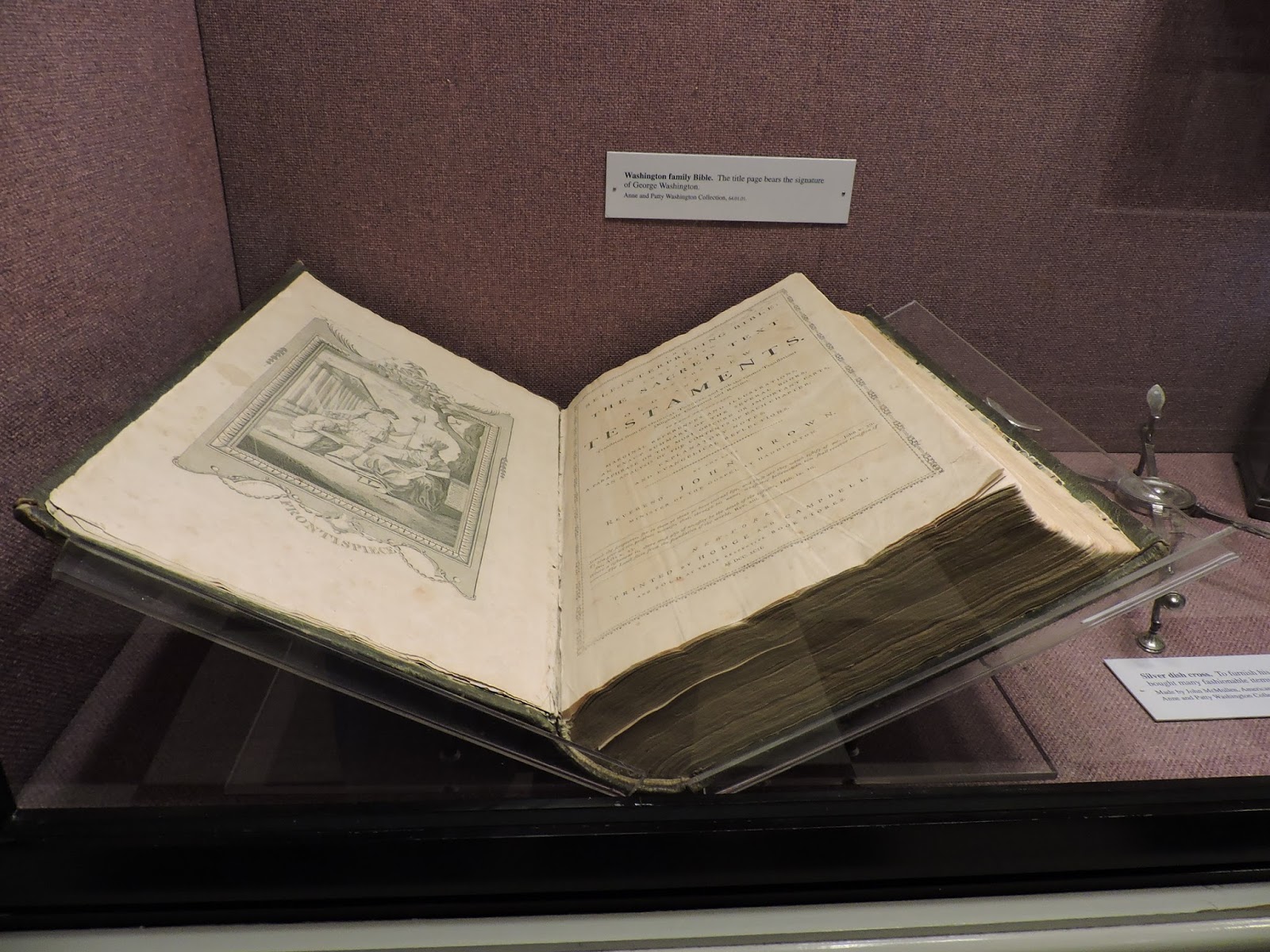
Washington's Bible
Perhaps my favorite room was the museum, which is located on the 4th Floor. Exhibits include a strand of Washington's hair, his family bible that bears his signature and a candle carried at his funeral.

After touring the Replica Lodge Room and the Knight Templar Chapel, we packed ourselves into two
View from the Observation Deck
small elevators and made our way to the 9th Floor which opens up to the outdoor observation deck. All I can say is WOW!!!!!!, What a view. The day was clear and sunny and from the observation deck we could see the Capitol and Washington Monument in distance as well as seeing planes landing and taking off at Reagan
National Airport. The view itself is will worth the price of admission.

The guided tour ends on the observation deck and we were free to revisit the Memorial Hall and other areas of the memorial.  I really enjoyed my visit and would encourage anyone in the Northern Virginia area to make time for this wonderful memorial.

Here is a short Video from my visit to the George Washington's Masonic National Memorial


Friday, March 31, 2017

OFF DAY IN GREENVILLE

(March 18, 2017) While the NCAA Men's Basketball tournament continued at other sites, there were no games scheduled for Greenville on Saturday. This gave me the Opportunity to get out and explore the area. As I drove through Greenville, I round several streets were blocked off for some kind of running event, so I headed back to Interstate 85 and made my way south toward the tiny town of Royston, Georgia.

Mos people don't play on going to Royston, they end up in Royston, but for me this was a planned trip. Royston is the town of one of the most immortal names in Baseball, Tyrus Raymond Cobb.  Ty Cobb was the first inductee into the National Baseball Hall of Fame and one of the true legends of the game.

As you drive through this small town it is evident that its citizens not only embrace his legacy but truly love the man.  Everywhere you look you see the name Ty Cobb. From the Community Center to the Ty Cobb Medical Center, it is obvious that this baseball legend was a philanthropist who really gave back to his hometown and
community.

The reason that I drove the hour and 20-minutes from Greenville to Royston was to visit the Ty Cobb Museum. The small museum is located in a wing of a small medical office building in downtown Royston.

The Ty Cobb Museum is a very small museum which features a number of artifacts that personally belong to the baseball great. When I tour a museum, I am a "reader," I enjoy reading the plaques and information that is available. With that being said, I spent about an hour walking through the exhibits, which featured Ty Cobb's Bible, Uniforms and shotgun along with other personal artifacts.

Just a short drive (less than a mile) from the museum is Rose Hill Cemetery, where Ty Cobb, his wife and mother and father are resting in a family mausoleum.  You have no trouble finding the mausoleum as it is the largest structure in the Cemetery.  I made a quick trip out to the cemetery before heading back toward South Carolina.

My next stop of the day was the small town of Pendleton, South Carolina. I wanted to stop of the Old Stone Church, which is one of the oldest churches in the upstate of South Carolina. However, there was a wedding going on and not wanting to be a "wedding crasher," I ventured over to the St. Paul's Episcopal Church. It is here in the church cemetery that Thomas Green Clemson and his wife Anna Calhoun Clemson are buried.

Thomas Clemson is the founder of Clemson University. and his wife Anna Calhoun is the daughter of Vice President John C. Calhoun. Following Vice President Calhoun's death in 1850, Thomas and Anna eventually inherited the Fort Hill Plantation.  It was from Fort Hill that Clemson founded the agricultural college that is today known as Clemson University.

General Barnard Bee


Also resting here in the church cemetery is Civil War General Barnard Elliott Bee. It was during the first battle of Manassas on July 21, 1861 that Bee uttered the words, "Rally around the Virginians, There stands Jackson like a stonewall." From that day forward General Thomas J. Jackson would be known as "Stonewall" Jackson. The next day on July 22, 1861, General Bee was kill on the battlefield at Manassas.

After finishing my quick visit to St. Paul's Church, I made a short drive up to Clemson University. My first stop was at Woodland Cemetery. It is here, in the shadow of Clemson's Memorial Stadium that legendary football coach Frank Howard is buried.  It was Howard that started referring to Memorial Stadium as Death Valley.

Also located at Woodland is the Fort Hill Plantation Cemetery and the Calhoun Family Cemetery. While Vice President Calhoun is buried in Charleston, several of his relatives are buried here.

Coach Howard's Rock
Just a short walk down the hill from Woodland Cemetery, is  Memorial Stadium, which is home to  2017 NCAA National Football Champions. Today the east gate was open and visitors could actually touch Howard's Rock and run down the hill.

A few years back I was able to attend the Clemson - Wake Forest Game here at Memorial Stadium. I must say if you are a college football fan, then attending a game in Death Valley should be on your bucket list. There is no way to describe the scene when the Tigers rub Howard's Rock, run down the hill and 85,000 people erupt. It is a totally awesome environment.

Fort Hill Plantation House
Just a short walk up the hill from Memorial Stadium is all that remains of the original Fort Hill Plantation; the home of Vice- President John C. Calhoun. When Calhoun died in 1850 the plantation was divided among his children. The home eventually became the home of Vice President daughter Anna Calhoun and her husband Thomas Green Clemson.

When Anna died in 1875, Thomas inherited the property. In his will Clemson bequeathed the property to the State of South Carolina for the purpose of establishing an agricultural college which is today known as Clemson University. Thomas also stipulated that the Fort Hill Mansion should never be torn down or altered and it should always be open for "Public Inspection." Today, Clemson University has preserved the historic home as a museum which contain almost all of the original furnishings.

By the time I finished with my visit to Clemson it was time to head back toward Greenville, but I had one more stop to make before returning to my hotel. Woodlawn Memorial Park is just a short drive up from my hotel on Plesantsburg Road and it is the final resting place of the one of the greatest baseball players who is NOT in the Hall of Fame, Joseph Jefferson "Shoeless Joe" Jackson.

In 1919 "Shoeless Joe" was a member of the Chicago White Sox who played in the World Series. Jackson discovered that seven players had gotten together to throw the World Series. He was offered $20,000 to join them but  adamantly declined. The gambler used his name to lure bettors and as a result Commissioner Kennesaw Mounatin Landis banned all of the player from professional baseball for life. Following the ban Joe returned to Greenville where he became a successful shop keeper, running a dry cleaning business and later a liquor store.  He lived the rest of his life here in Greenville and died of a heart attack in 1951.

After paying my respects to "Shoeless Joe" I ended my day with dinner at Sticky Fingers BBQ and returned to my hotel to watch the evening session of the tournament.